Descuento:
-5%Antes:
Despues:
191,90 €1 Introduction
2 Digital Image Fundamentals
3 Intensity Transformations and Spatial Filtering
4 Filtering in the Frequency Domain
5 Image Restoration and Reconstruction
6 Wavelet and Other Image Transforms
7 Color Image Processing
8 Image Compression and Watermarking
9 Morphological Image Processing
10 Image Segmentation I: Edge Detection,
11 Image Segmentation II: Active Contours: Snakes and Level Sets
12 Feature Extraction
13 Image Pattern Classification
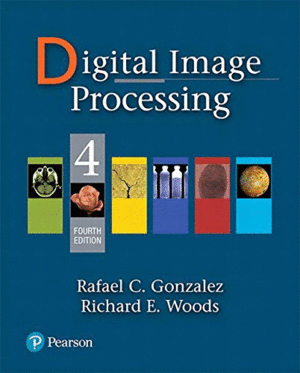
For 40 years, Image Processinghas been the foundational text for the study of digital image processing. The book is suited for students at the college senior and first-year graduate level with prior background in mathematical analysis, vectors, matrices, probability, statistics, linear systems, and computer programming. As in all earlier editions, the focus of this edition of the book is on fundamentals.
The 4th Edition, which celebrates the book’s 40th anniversary, is based on an extensive survey of faculty, students, and independent readers in 150 institutions from 30 countries. Their feedback led to expanded or new coverage of topics such as deep learning and deep neural networks, including convolutional neural nets, the scale-invariant feature transform (SIFT), maximally-stable extremal regions (MSERs), graph cuts, k-means clustering and superpixels, active contours (snakes and level sets), and exact histogram matching. Major improvements were made in reorganizing the material on image transforms into a more cohesive presentation, and in the discussion of spatial kernels and spatial filtering. Major revisions and additions were made to examples and homework exercises throughout the book. For the first time, we added MATLAB projects at the end of every chapter, and compiled support packages for students and faculty containing, solutions, image databases, and sample code.
Features
Provide an introduction to basic concepts and methodologies applicable to digital image processing
• Timely, highly readable, and heavily illustrated with numerous examples of practical significance.
- NEW! This edition contains 425 new images, 135 new drawings, and 220 new exercises.
• Focuses on the fundamental material whose scope of application is not limited to the solution of specialized problems
• Updated with feedback from an extensive survey that involved faculty, students, and independent readers of the book in 150 institutions from 30 countries.
- UPDATED! A complete update of the image pattern recognition chapter to incorporate new material on deep neural networks, backpropagation, deep learning, and, especially, deep convolutional neural networks.
- EXPANDED! Coverage of feature extraction, including the Scale Invariant Feature Transform (SIFT, maximally stable extremal regions (MSERs), and corner detection.
- NEW! Coverage of graph cuts and their application to segmentation.
- NEW! A discussion of superpixels and their use in region segmentation.
- NEW! An introduction to segmentation using active contours (snakes and level sets).
- NEW! Material related to exact histogram matching.
- EXPANDED! Coverage of the fundamentals of spatial filtering, image transforms, and finite differences with a focus on edge detection.
• NEW! Two new chapters:
- A chapter dealing with active contours for image segmentation, including snakes and level sets.
- A chapter that brings together wavelets, several new transforms, and many of the image transforms that were scattered throughout the book.
• NEW! 120 MATLAB projects, located at the end of every chapter and are structured in a unique way that gives instructors significant flexibility in how projects are assigned.
- The MATLAB functions required to solve all the projects in the book are provided in executable, p-code format which makes it possible for projects to be assigned solely for the purpose of experimenting with image processing concepts, without having to write a single line of code.
- Alternatively, when instructors elect to assign projects that involve MATLAB code development, we provide students enough answers to form a good base that they can expand, thus gaining experience with developing software solutions to image processing problems
 -5%
-5%
 -5%
-5%
 -5%
-5%
 -5%
-5%
 -5%
-5%
 -5%
-5%
 -5%
-5%
 -5%
-5%
 -5%
-5%
 -5%
-5%