Descuento:
-5%Antes:
Despues:
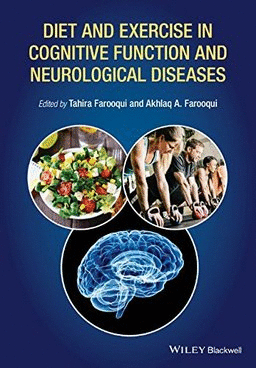
183,97 €Diet and exercise have long been recognized as important components of a healthy lifestyle, as they have a great impact on improving cardiovascular and cerebrovascular functions, lowering the risk of metabolic disorders, and contributing to healthy aging. As a greater proportion of the world’s population is living longer, there has been increased interest in understanding the role of nutrition and exercise in long-term neurological health and cognitive function.
Diet and Exercise in Cognitive Function and Neurological Diseases discusses the role and impact that nutrition and activity have on cognitive function and neurological health. The book is divided into two sections. The first section focuses on diet and its impact on neurobiological processes. Chapters focus on the impacts of specific diets, such as the Mediterranean, ketogenic and vegan diets, as well as the role of specific nutrients, fats, fatty acids, and calorie restriction on neurological health and cognitive function. The second section of the book focuses on exercise, and its role in maintaining cognitive function, reducing neuroinflammatory responses, regulating adult neurogenesis, and healthy brain aging. Other chapters look at the impact of exercise in the management of specific neurological disorders such Multiple Sclerosis and Parkinson’s Disease.
Diet and Exercise in Cognitive Function and Neurological Diseases is a timely reference on the neurobiological interplay between diet and exercise on long-term brain health and cognitive function.
Authors
Tahira Farooqui and Akhlaq A. Farooqui, The Ohio State University, Columbus, OH, USA.
Table of Contents
1 Nutrition, Genes, and Neuroscience: Implications for Development, Health, and Disease 1
2 Neurochemical Effects of Western Diet Consumption on Human Brain 15
3 Effect of Mediterranean Diet on Human Health in Seniors: Relationship with Telomers 29
4 Effect of a Mediterranean Diet on Mental and Physical Quality of Life 39
5 Ketogenic Diets for the Treatment of Neurologic Disease 47
6 Levels of n-3 Fatty Acids and their Metabolites in the Brain: Their Impact on Brain Function and Neurological Disorders 59
7 Homocysteine Levels in Neurological Disorders 73
8 Table Salt and Dementia 83
9 Contribution of Diet and Exercise in the Pathogenesis of Major Depression 93
10 Role of Diet and Exercise in Diabetic Retinopathy 105
11 The Effect of Western Diet on Cognition in Humans 111
12 Role of Diet and Exercise in Intervention of Age-Induced Impairments 123
13 Hormesis and Cognitive Function: An Evolutionary/Adaptive Arabesque Leading to Longevity 133
14 Polyphenols and Cognitive Function 143
15 Prevention of Dementia Through Modifiable Risk Factors 163
16 Physical Exercise Improves Cognition in Brain Disorders: Alzheimer’s Disease 175
17 Molecular, Biochemical, and Physiological Basis of Beneficial Actions of Exercise 183
18 Beneficial Effects of Exercise and Cognitive Training on Cognitive Functions in Older Adults: Introduction of Smart Aging Studies 205
19 Exercise and Cognitive Functions 213
20 Role of Sleep in Cognition, Immunity, and Disease and Its Interaction with Exercise 225
21 Effect of Forced and Voluntary Exercise on Neural Plasticity Mediated by Astrocytes 241
22 Effect of Exercise on the Aging Brain 253
23 The Effects of Exercise on Neuronal Survival 267
24 Exercise and Cognitive Function in Older Adults 279
25 Research Issues and Clinical Implications of Exercise Effects in the Treatment of Depressive and Anxiety Disorders 295
26 Exercise-Induced Protection Against Aging and Neurodegenerative Diseases: Role of Redox- and Mitochondrial-Based Alterations 309
27 Exercise, Neuroplasticity, and Growth Factors in Adolescence 323
28 Summary, Perspective, and Direction for Future Studies 339
Index 349
 -5%
-5%
 -5%
-5%
 -5%
-5%
 -5%
-5%
 -5%
-5%
 -5%
-5%
 -5%
-5%
 -5%
-5%
 -5%
-5%
 -5%
-5%