Descuento:
-5%Antes:
Despues:
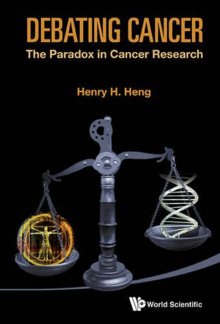
148,20 €Cancer research is at a crossroads. Traditionally, cancer has been thought of as a disease of gene mutation, where the stepwise accumulation of cancer gene mutations is the key, and the identification of common gene mutations has been considered to be essential for diagnosis and treatment. Despite extensive research efforts and accumulated knowledge on cancer genes and pathways, the clinical benefits of this traditional approach have been limited. Recently, cancer genome sequencing has revealed an extensive amount of genetic heterogeneity where the long-expected common mutation drivers have been difficult, if not impossible, to identify. These realities ultimately challenge the conceptual framework of current cancer biology.
This book introduces a new concept of genome theory of cancer evolution, in an attempt to unify the field. Many important and representative, but often confusing, questions and paradoxes are critically analyzed. By comparing gene- and genome-based theories, the hidden flaws of many popular viewpoints are addressed. This discussion is intended to initiate a much-needed critical re-evaluation of current cancer research.
Readership: This book will be appreciated by the research community at large. It will also serve as an excellent resource for a wide range of readers, including researchers, graduate students, physicians, science reporters, and even policy-makers.
Author
Henry H Heng (Wayne State University School of Medicine, USA)
Contents:
Introduction: Why Debate Cancer, and Why Now?
The Gene Mutation Theory of Cancer
Alternative Theories to Explain Cancer
The Surprise Cancer Genome Landscape Revealed by Cancer Genome Sequencing Projects
Unraveling the Mystery of Cancer: Understanding Genome Variation Mediated Cancer Evolution
Significance of the Insignificant: Why "Noise" is Essential for Cancer Evolution
Do Different Cancers Represent Different Species?
Facts vs. Myths
 -5%
-5%
 -5%
-5%
 -5%
-5%
 -5%
-5%
 -5%
-5%
 -5%
-5%
 -5%
-5%
 -5%
-5%
 -5%
-5%
 -5%
-5%