Descuento:
-5%Antes:
Despues:
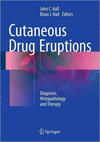
148,19 €The burden of cutaneous drug reactions is significant, in both outpatient and inpatient settings, and can result in morbidity and even mortality. This book is unique in its approach to this problem.
This text is divided into basic principles, common drug reactions, skin conditions mimicked by drug reactions, drug reactions to the skin appendages, life-threatening drug reactions, less common drug reactions, and special groupings of drug reactions.
For the clinician, the skin can only morphologically react in to many limited ways. This is also true for the pathologist. Combining these two forever linked specialties is a synergistic paradigm that greatly enhances diagnosis, and ultimately therapy, for these pernicious conditions. Drug reactions in the skin remain a common complication of therapy. True incidences of drug reactions are not available. For general discussion, the rule of 3% can be applied with reasonable assuredness. Approximately 3% of all hospitalized patients develop an adverse cutaneous drug reaction. Approximately 3% of these reactions are considered severe. Outpatient data is even more obscure, but at least 3% of dermatology clinic outpatient visits are due to a drug reaction. Cutaneous drug reactions compromise approximately 3% of all drug reactions. Even more challenging is the fact that the most vulnerable populations to drug reactions are increasing and include the elderly patients on prolonged drug therapy, and patients that use multiple drugs at the same time.
Feature:
- Summary and reference of all skin problems related to medications
- Contains photographs of clinical and histological diagnoses
- Detailed algorithmic approach to diagnosis and therapy for skin diseases caused by drugs.
Authors
Dr. John C. Hall graduated from the University of Nebraska College of Medicine in 1972. He works in Kansas City, MO and specializes in Dermatology. Dr. Hall is affiliated with Saint Lukes Hospital Of Kansas City and Truman Medical Center Hospital Hill.
Brian Hall completed his pathology residency at the University of Utah followed by a dermatopathology fellowship under Clay J. Cockerell at UT Southwestern Medical School in the Department of Dermatology. He has co-edited six dermatology and pathology textbooks with his father, John C. Hall, a well-known dermatologist in the Kansas City area.
Table of contents (38 chapter)
1.Immunology of Cutaneous Drug Eruptions
2.Principles of Diagnosis of Cutaneous Drug Eruptions
3.Histopathology of Drug Reactions
4.Principles of Treatment of Cutaneous Drug Eruptions
5.Morbilliform Drug Eruptions
6.Drug-Induced Urticaria
7.Erythema Multiforme and Drug Reactions
8.Drug-Induced Vasculitis
9.Pigment Changes and Drug Reactions
10.Drug-Induced Photosensitivity
11.Erythema Nodosum as a Drug Eruption
12.Lichen Planus Drug Reactions
13.Pityriasis Rosea-Like Drug Eruptions
14.Psoriasiform Drug Eruptions and Drugs That Flare Psoriasis
15.Acne and Drug Reactions
16.Collagen Vascular Diseases and Cutaneous Drug Reactions
17.Fixed Drug Eruptions
18.Autoimmune Bullous Diseases and Drugs
19.Lymphoma and Pseudolymphoma and Drug Reactions
20.Drug-Induced Alopecia
21.Drug Eruptions of the Scalp
22.Drug Reactions in the Nail in Cutaneous Drug Eruptions
23.Drug Eruptions and Erythroderma
24.Stevens–Johnson Syndrome and Toxic Epidermal Necrolysis
25.Drug-Induced Delayed Multi-organ Hypersensitivity Syndrome
26.Acute Generalized Exanthematous Pustulosis
27.Cutaneous Drug Reactions to Anticoagulants
28.Antiepileptic Medications and Cutaneous Drug Reactions
29.Chemotherapy and Cutaneous Drug Reactions
30.Tyrosine Kinase Medications and the Skin
31.Medical Therapies and Their Effects on Skin Cancer
32.Cutaneous Reactions to BRAF Inhibitors
33.Cutaneous Reactions to Corticosteroids
34.Cutaneous Reactions to Retinoids
35.Neutrophilic Dermatoses
36.Granulomatous Drug Reactions
37.Cutaneous Drug Reactions in Patients Infected with Human Immunodeficiency Virus
38.Pediatric Drug Eruptions of the Skin
 -5%
-5%
 -5%
-5%
 -5%
-5%
 -5%
-5%
 -5%
-5%
 -5%
-5%
 -5%
-5%
 -5%
-5%
 -5%
-5%
 -5%
-5%