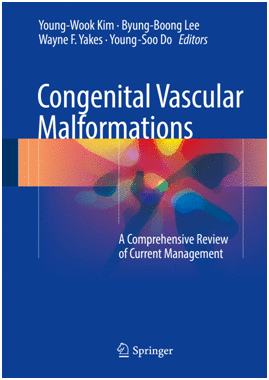
KIM, Y.; LEE, B.; YAKES, W.; DO, Y.
Descuento:
-5%Antes:
Despues:
158,07 €1. Congenital Vascular Malformations: An Historical Account
2. Embryological Background of Congenital Vascular Malformations
3. Angiogenesis and Vascular Malformations
4. Genetic Aspects of Vascular Malformations
5. Epidemiologic Aspect of Congenital Vascular Malformation
6. Provoking Factors for Aggravation of Congenital Vascular Malformation
7. General Overview
8. ISSVA Classification of Vascular Anomalies
9. Hamburg Classification: Vascular Malformation
10. Angiographic Classification: Arteriovenous Malformation and Venous Malformation
11. New Arteriographic Classification of AVM Based on the Yakes Classification System
12. General Overview
13. Differential Diagnosis from Hemangioma
14. Venous Malformation of the Head and Neck and Extremities
15. Venous Malformation: Truncular Form
16. Hemolymphatic Malformation: Mixed Form Congenital Vascular Malformation
17. Arteriovenous Malformations (AVMs): Clinical Features and Evaluation
18. Lymphatic Malformation (LM) (Extratruncular): Lymphangioma
19. Truncular Lymphatic Malformation (LM): Primary Lymphedema
20. Clinical Features and Evaluation of Superficial & Deep Capillary Malformation (CM)
21. Contemporary Diagnosis: Imaging Modalities – Overview
22. Contemporary Diagnosis: MRI and MRA
23. Ultrasonography in the Diagnosis of Congenital Vascular Malformation
24. CT and CT Angiogram in the Diagnosis of Congenital Vascular Malformations
25. Microscopic Lymphangiography
26. MR Lymphangiography
27. Management of Congenital Vascular Malformation: Overview
28. Endovascular Treatment of Vascular Malformation: An Overview
29. Endovascular Treatment of Venous Malformation in the Head and Neck, Trunk, and Extremities
30. Endovascular Treatment of AVMs: Head and Neck
31. Endovascular Treatment of AVM: Trunk and Extremity
32. Management of Lymphatic Malformations
33. Complications of Endovascular Treatment of Peripheral Congenital Vascular Malformations
34. Surgical Treatment of Low-Flow CVM
35. Surgical Treatment for High-Flow CVM
36. Combined Surgical and Endovascular Approaches
37. Management of Deep Vein Aplasia, Hypoplasia, and Lateral Marginal Vein
38. Surgical Treatments for Lymphedema
39. Complex Decongestive Therapy of Primary Lymphedema
40. Laser Therapy of Superficial and Deep Capillary Malformation (CM): Principles of Laser Technology
41. Conservative/Medical Treatment of CVM
42. Multidisciplinary Team Approach for Patients with Congenital Vascular Malformation (CVM): Experience at Samsung Medical Center
43. Congenital Vascular Bone Syndrome: Limb Length Discrepancy
44. Biological Approaches to the Aggressive CVM Lesion (Antiangiogenic Therapy)
45. Pelvic Arteriovenous Malformation (AVM)
46. Treatment Strategy on Chylolymphatic/Lymphatic Reflux
47. Treatment Strategy on Neonatal and Infant CVMs
48. Strategy in Pediatric Patients
This book is a superbly illustrated guide to the diagnosis and treatment of congenital vascular malformations (CVMs) that will enable the reader to avoid the serious pitfalls that may arise when caring for patients with this rare and complex group of lesions. After discussion of pathogenesis, classification, and differential diagnosis from vascular tumors, the clinical features of CVMs are described and illustrated, covering both the various forms (venous, arteriovenous, lymphatic, capillary, and mixed) and presentations at different anatomic sites. The current role of CT, MRI, scintigraphy, and angiography in diagnostic evaluation is explained, and treatment options, including conservative treatment, are then considered in detail. The discussion of endovascular treatment, or embolo-sclerotherapy, includes instruction on patient selection, embolic and sclerosing materials, access to the target lesion, site-specific variations in treatment strategy, and complications and their management. Indications for and performance of surgical/excisional therapy and laser therapy are also fully considered.
Features
• Describes clinical features
• Explains the role of different imaging modalities in diagnostic evaluation
• Discusses treatment options and their indications in detail
• Contains a wealth of illustrations
Authors
Young-Wook Kim MD PhD, professor in Surgery, Sungkyunkwan University School of Medicine, Vascular Surgery, Samsung Medical Center Byung-Bong Lee MD PhD, professor in Surgery, George Washington University, George Washington University Medical Center Wyane F. Yakes MD, Director at Vascular Malformation Center Young-Soo Do MD PhD, professor in Radiology, Sungkyunkwan University School of Medicine, Interventional Radiology, Samsung Medical Center
 -5%
-5%
 -5%
-5%
 -5%
-5%
 -5%
-5%
 -5%
-5%
 -5%
-5%
 -5%
-5%
 -5%
-5%
 -5%
-5%
 -5%
-5%