Descuento:
-5%Antes:
Despues:
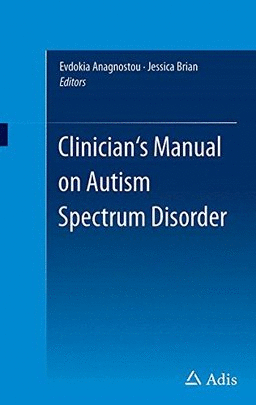
59,27 €- A practical clinical handbook providing an overview of best-practice management of autism spectrum disorder
- Includes up-to-date clinical guidelines, including the milestone fifth edition of the Diagnostic and Statistical Manual of Mental Disorders (DSM-5) in which several related disorders now come under the autism spectrum disorder diagnosis
- An ideal resource for busy clinicians and trainees that seek evidence-based, concisely written, patient-focused information to enhance their understanding of this increasingly common disorder
Autism spectrum disorder (ASD) is a developmental disorder characterised by disturbance in language, perception and social skills that affects an estimated 1–2 per 1,000 people worldwide (although the number is as high as 20 per 1000 in the US). In 2013, a single category of ASD united several related conditions (classical autism, Asperger’s syndrome, Fragile X Syndrome, Landau-Kleffner Syndrome, Rett syndrome, childhood disintegrative disorder, and PDD-NOS) was included in the DSM-5, with the aim to provide a more precise definition to will guide more consistent diagnoses and treatment. While studies have suggested a disturbance in neural metabolism in patients with ADS, the exact cause of the condition still remains unknown. Managing Autism Spectrum Disorder will serve a practical handbook supporting the diagnosis, treatment and long-term management of this condition, including behavioral therapies and emerging treatments.
Content Level » Professional/practitioner
Keywords » Autism spectrum disorder - Autism treatment - Behavioral intervention - Educational intervention - Neuropsychological assessment
Related subjects » Adis
AUTHORS & EDITORS
Dr. Evdokia Anagnostou joined Bloorview Kids Rehabilitation Centre in 2008 as a clinician-scientist. Dr. Anagnostou was Assistant Professor and Clinical Director of the Seaver Autism Center of Excellence from the Mount Sinai School of Medicine in New York. Dr. Anagnostou's primary appointment is in the Division of Developmental Medicine, Department of Paediatrics, University of Toronto a cross-appointment to the Division of Neurology, Department of Paediatics, University of Toronto at SickKids. Dr. Anagnostou completed medical school at McGill University in 1998 and her residency in child neurology in 2003. Dr. Anagnostou's research focuses on the psychopharmacology, neuroimaging and the development of clinical trials to test novel compounds for the treatment of autism and related disorders. Dr. Anagnostou is also studying the developmental trajectory of abnormalities in the frontostriatal circuitry in autism, and exploring the mechanisms of treatment response and side effects generation using fMRI, MR spectroscopy and DTI techniques.
Table of contents (8 chapters)
1.Introduction
2.Diagnosis: screening, surveillance, assessment, and formulation
3.Common psychiatric comorbidities and their assessment
4.Medical comorbidities in autism spectrum disorder
5.Pharmacotherapy in autism spectrum disorder
6.Behavioral and educational interventions
7.Autism spectrum disorder and the family: examining impacts and the need for support
8.Future directions
 -5%
-5%
 -5%
-5%
 -5%
-5%
 -5%
-5%
 -5%
-5%
 -5%
-5%
 -5%
-5%
 -5%
-5%
 -5%
-5%
 -5%
-5%