Descuento:
-5%Antes:
Despues:
118,75 €HISTORY AND METHODS
• Early Research on Circadian Rhythms
Remote Past
Twentieth Century
Current Trends
Ethics of Animal Research
Summary
Exercises
Suggestions for Further Reading
Websites to Explore
References
• Research Methods in Circadian Physiology
Scientific Method
Research on Populations and Organisms
Research on Organs, Cells, and Molecules
Research on the Environment
Summary
Exercises
Suggestions for Further Reading
Websites to Explore
References
• Analysis of Circadian Rhythmicity
Data Analysis
Parameters of Circadian Rhythms
Statistical Significance
Summary
Exercises
Suggestions for Further Reading
Websites to Explore
References
PHENOMENOLOGY
• Ultradian and Infradian Rhythms
Environmental Rhythms
Ultradian Rhythms
Infradian Rhythms
Annual Rhythms
Summary
Exercises
Suggestions for Further Reading
Websites to Explore
References
• Daily and Circadian Rhythms
Environmental and Populational Rhythms
Behavioral Rhythms
Autonomic Rhythms
Summary
Exercises
Suggestions for Further Reading
Websites to Explore
References
MECHANISMS
• Endogenous Mechanisms
Endogenous Rhythmicity
Inheritance Mechanisms
Single or Multiple Oscillators
Summary
Exercises
Suggestions for Further Reading
Websites to Explore
References
• Photic Environmental Mechanisms
Nonparametric Theory of Entrainment
Photic Parameters
Synthesis and Models
Summary
Exercises
Suggestions for Further Reading
Websites to Explore
References
• Nonphotic Environmental Mechanisms
Nonphotic Entrainment
Searching for a Common Mechanism
Separate Food-Entrainable Pacemaker
Summary
Exercises
Suggestions for Further Reading
Websites to Explore
References
• Integration of Mechanisms
Internal Temporal Order
Ecology and Evolution
Lifetime Changes
Summary
Exercises
Suggestions for Further Reading
Websites to Explore
References
• Homeostasis and Circadian Rhythmicity
Temperature Regulation
Sleep, Feeding, and Energy Expenditure
Summary
Exercises
Suggestions for Further Reading
Websites to Explore
References
PHYSICAL SUBSTRATES
• Receptors
Sensory Input
Photic Receptors
Nonphotic Receptors
Summary
Exercises
Suggestions for Further Reading
Websites to Explore
References
• Pacemakers
Suprachiasmatic Nucleus
Cellular Processes
Molecular Processes
Other Pacemakers
Summary
Exercises
Suggestions for Further Reading
References
• Afference and Efference
Afferent Pathways
Efferent Pathways
Summary
Exercises
Suggestions for Further Reading
Websites to Explore
References
APPLICATIONS
• Optimal Timing on Earth and in Space
Patterns of Human Mobility
Best Time for Sports and Intellectual Activities
Space Exploration
Summary
Exercises
Suggestions for Further Reading
Websites to Explore
References
• Jet-Lag and Shift Work
Jet-Lag Syndrome
Shift-Work Malaise
Daylight-Saving Time
Summary
Exercises
Suggestions for Further Reading
Websites to Explore
References
• Human Medicine
Chronotherapeutics
Sleep Disorders
Depression
Summary
Exercises
Suggestions for Further Reading
Websites to Explore
References
• Pet Selection and Veterinary Medicine
Pet Selection
Veterinary Medicine
Summary
Exercises
Suggestions for Further Reading
Websites to Explore
References
Appendix A: Assessment of Learning
Appendix B: Dictionary of Circadian Physiology
Appendix C: Organisms Used
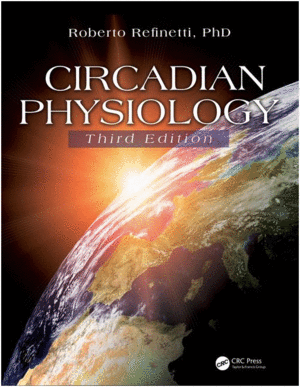
Circadian rhythms influence most of our life activities, notably getting up and going to sleep every day. This new edition of Circadian Physiology delves into the mechanisms surrounding how these rhythms work, the physiology and biology behind them, and the latest research on this cutting-edge field. The book also discusses a wide variety of practical topics including the prevention of jet lag, management of shift work, sleep disorders, depression, and the optimal times for physical and intellectual activities.
To facilitate its use as a textbook, the book contains summaries, suggestions for further reading, links to pertinent websites, and exercises at the end of each chapter. It also includes software for data analysis, tutorials, and simulation programs discussed throughout the text. In addition, more than a thousand references have been added, resulting in a total of more than 6000 references.
The text has been thoroughly updated as a result of major advances in recent years. This edition adds discussion on the anatomical and physiological characterization of photoresponsive ganglionic cells in the mammalian retina, molecular circadian clocks in cells of multiple organs other than the hypothalamus and the pineal gland, and advances in the understanding of post-translational mechanisms in the operation of the molecular clock.
Features
• Offers a rigorous review of both basic and applied research on circadian rhythms
• Updates all chapters in light of recent research and clinical developments
• Includes a summary, didactical exercises, suggestions for further reading, and related websites in each chapter
• Provides free software for data analysis as well as tutorials and simulation programs discussed throughout the text
• Presents new material on the anatomical and physiological characterization of photoresponsive ganglionic cells in the mammalian retina, molecular circadian clocks in cells of multiple organs, and advances in the understanding of post-translational mechanisms in the operation of the molecular clock
Author
Roberto Refinetti, PhD, is a physiological psychology professor, circadian physiology researcher, and chair of the department of psychology at Boise State University in Idaho, USA. He is also a member of the graduate faculty of the University of Messina (Italy) and was formerly associated with the University of South Carolina, the University of Virginia, the University of Illinois, the University of São Paulo (Brazil), and the University of California at Santa Barbara, where he earned his doctorate. His research program in circadian physiology, which concentrates on the integration of circadian and homeostatic mechanisms, has been funded by the U.S. National Science Foundation and the National Institutes of Health. Professor Refinetti is editor-in-chief of the Journal of Circadian Rhythms and of the interdisciplinary journalSexuality & Culture.
 -5%
-5%
 -5%
-5%
 -5%
-5%
 -5%
-5%
 -5%
-5%
 -5%
-5%
 -5%
-5%
 -5%
-5%
 -5%
-5%
 -5%
-5%