Descuento:
-5%Antes:
Despues:
76,98 €Preface
Preamble
1. Introduction to case-control studies
2. The simplest situation
3. Matched case-control studies
4. A general formulation
5. Case-control studies with other than two outcomes
6. Special sampling designs
7. Nested case-control studies
8. Case-subcohort studies
9. Misclassification and measurement error
10. Synthesis of studies
Appendix. A theoretical diversion
References
Index.
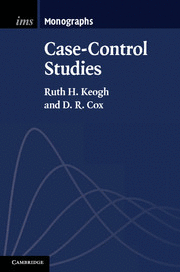
The case-control approach is a powerful method for investigating factors that may explain a particular event. It is extensively used in epidemiology to study disease incidence, one of the best-known examples being Bradford Hill and Doll's investigation of the possible connection between cigarette smoking and lung cancer. More recently, case-control studies have been increasingly used in other fields, including sociology and econometrics. With a particular focus on statistical analysis, this book is ideal for applied and theoretical statisticians wanting an up-to-date introduction to the field. It covers the fundamentals of case-control study design and analysis as well as more recent developments, including two-stage studies, case-only studies and methods for case-control sampling in time. The latter have important applications in large prospective cohorts which require case-control sampling designs to make efficient use of resources. More theoretical background is provided in an appendix for those new to the field.
Features
• Written specifically for statisticians
• Covers important developments in the field from the past 30 years
• May be used as the basis for a short postgraduate course
Authors
• Ruth H. Keogh, London School of Hygiene and Tropical Medicine
Ruth H. Keogh is a Lecturer in the Department of Medical Statistics at the London School of Hygiene and Tropical Medicine.
• D. R. Cox, University of Oxford
D. R. Cox is one of the world's pre-eminent statisticians. His work on the proportional hazards regression model is one of the most-cited and most influential papers in modern statistics. In 2010 he won the Copley Medal of the Royal Society 'for his seminal contributions to the theory and application of statistics'. He is currently an Honorary Fellow at Nuffield College, Oxford.
 -5%
-5%
 -5%
-5%
 -5%
-5%
 -5%
-5%
 -5%
-5%
 -5%
-5%
 -5%
-5%
 -5%
-5%
 -5%
-5%
 -5%
-5%