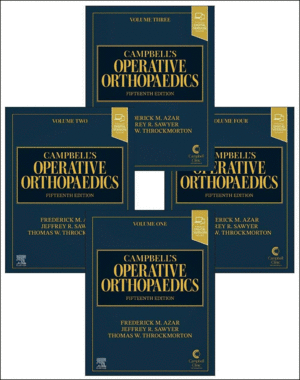
AZAR, F.; SAWYER, J.R.; THROCKMORTON, T.
Descuento:
-5%Antes:
Despues:
584,25 €1. Surgical Techniques
2. Perioperative Patient Optimization and Overview of Tendon-to-Bone Fixation and Bone Grafting
3. Advanced Imaging in Orthopaedics
4. Arthroplasty of the Hip
5. Surface Replacement Hip Arthroplasty
6. Arthrodesis of the Hip
7. Hip Pain in the Young Adult and Hip Preservation Surgery
8. Arthroplasty of the Knee
9. Arthrodesis of the Knee
10, Knee Preservation Surgery
11. Total Ankle Arthroplasty
12. Ankle Arthrodesis
13. Shoulder Arthroplasty
14. Open Reconstructive Procedures of the Shoulder
15. Reconstructive Procedures of the Elbow
16. General Principles of Amputations
17. Amputations of the Foot
18. Amputations of the Lower Extremity
19. Amputations of the Hip and Pelvis
20. Major Amputations of the Upper Extremity
21. Amputations of the Hand
22. General Principles of Infection
23. Osteomyelitis
24. Infectious Arthritis
25. Tuberculosis and Other Unusual Infections
26. General Principles of Tumor
27. Benign Bone Tumors and Nonneoplastic Conditions Simulating Bone Tumors
28. Benign / Aggressive Tumors of Bone
29. Malignant Tumors of Bone
30. Soft-Tissue Tumors
31. Congenital Anomalies of the Lower Extremity
32. Congenital and Developmental Abnormalities of the Hip and Pelvis
33. Congenital Anomalies of the Trunk and Upper Extremity
34. Osteochondrosis or Epiphysitis and Other Miscellaneous Affections
35. Cerebral Palsy
36. Paralytic Disorders
37. Neuromuscular Disorders
38. Fractures and Dislocations in Children
39. Pediatric Cervical Spine
40. Scoliosis
41. Kyphosis
42. Spondylolisthesis (Adolescent)
43. Anatomy of the Spine
44. Approaches to the Cervical, Thoracic, and Lumbar Spine
45. Degenerative Disorders of the Cervical Spine
46. Degenerative Disorders of the Thoracic and Lumbar Spine
47. Adult Spinal Deformity
48. Fractures, Dislocations, and Fracture-Dislocations of the Spine
49. Infections and Tumors of the Spine
50. Knee Injuries
51. Shoulder and Elbow Injuries
52. Recurrent Dislocations
53. Traumatic Disorders
54. General Principles of Arthroscopy
55. Arthroscopy of the Foot And Ankle
56. Arthroscopy of the Lower Extremity
57. Arthroscopy of the Upper Extremity
58. General Principles of Fracture Treatment
59. Fractures of the Lower Extremity
60. Fractures and Dislocations of the Hip
61. Fractures of the Acetabulum and Pelvis
62. Fractures of the Shoulder, Arm, and Forearm
63. Malunited Fractures
64. Delayed Union and Nonunion of Fractures
65. Acute Dislocations
66. Old Unreduced Dislocations
67. Peripheral Nerve Injuries
68. Microsurgery
69. Basic Surgical Technique and Postoperative Care
70. Acute Hand Injuries
71. Flexor and Extensor Tendon Injuries
72. Fractures, Dislocations, and Ligamentous Injuries of the Hand and Wrist
73. Nerve Injuries at the Level of the Hand and Wrist
74. Wrist Disorders
75. Special Hand Disorders
76. Paralytic Hand
77. Cerebral Palsy of the Hand
78. Arthritic Hand
79. Compartment Syndromes and Volkmann Contracture
80. Dupuytren Contracture
81. Stenosing Tenosynovitis of the Wrist and Hand
82. Compressive Neuropathies of the Hand, Forearm, and Elbow
83. Tumors and Tumorous Conditions of the Hand
84. Hand Infections
85. Congenital Anomalies of the Hand
86. Surgical Techniques of the Foot and Ankle
87. Disorders of the Hallux
88. Disorders of the Tendons and Fascia and Adolescent and Adult Acquired Flatfoot Deformity
89. Lesser Toe Abnormalities and Disorders of Nails
90. Arthritis of the Foot
91. Neuropathic Foot
92. Neurogenic Disorders
93. Fractures and Dislocations of the Foot
94. Sports Injuries of the Ankle
Instrucciones concisas y sencillas para la lectura e interpretación del EEG.
Práctico, breve y de fácil comprensión, Rowan. Conceptos básicos de EEG, 3.a edición, clarifica los complejos aspectos técnicos de la realización e interpretación del EEG. Su estilo directo y conciso, su enfoque didáctico y sus numerosas ilustraciones, además de una extensa videoteca complementaria, hacen de esta obra de referencia actualizada un valioso recurso para estudiantes, residentes, neurólogos y especialistas en epilepsia.
• Presenta un atractivo diseño en color, y cuenta con explicaciones breves y precisas de expertos en la materia.
• Aborda los últimos avances en este campo, como el EEG intracraneal y el EEG cuantitativo en la UCI.
• Incluye 50 vídeos con ejemplos de crisis comiciales y la interpretación de los respectivos EEG.
• Cada vídeo se muestra con y sin anotaciones de los autores, de modo que se puede practicar la lectura de los EEG y a continuación comprobar la propia interpretación consultando las anotaciones (en inglés).
• Ofrece una cobertura ampliada de los síndromes epilépticos, con una tabla de consulta rápida que resume las edades de inicio, los pronósticos y las características clínicas y electroencefalográficas.
• Trata también el EEG en el paciente pediátrico, e incluye una tabla que resume los cambios a lo largo del período neonatal.
• Cuenta con preguntas de autoevaluación online para cada capítulo.
• Utiliza la nomenclatura actualizada recientemente por la International League Against Epilepsy y la American Clinical Neurophysiology Society.
• Incluye el acceso a la versión electrónica del libro. Este ebook permite acceder a todo el texto, las figuras y la bibliografía, así como a la videoteca y las preguntas de autoevaluación.
Authors
• Frederick M. Azar, MD, Professor, Department Department of Orthopaedic Surgery, University of Tennessee- Campbell Clinic; Chief of Staff, Campbell Clinic, Memphis, Tennessee, USA.
• Jeffrey R. Sawyer, Professor, Campbell Clinic Department of Orthopaedic Surgery and Biomedical Engineering, University of Tennessee Health Science Center, Memphis, Tennessee, USA.
• Thomas W. Throckmorton, Professor, Campbell Clinic Department of Orthopaedic Surgery and Biomedical Engineering, University of Tennessee Health Science Center, Memphis, Tennessee, USA
 -5%
-5%
 -5%
-5%
 -5%
-5%
 -5%
-5%
 -5%
-5%
 -5%
-5%
 -5%
-5%
 -5%
-5%
 -5%
-5%
 -5%
-5%