Descuento:
-5%Antes:
Despues:
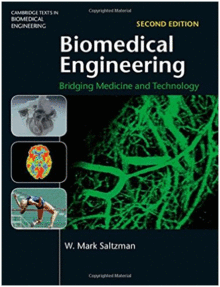
69,16 €The second edition of this popular introductory undergraduate textbook uses examples, applications, and profiles of biomedical engineers to show students the relevance of the theory and how it can be used to solve real problems in human medicine. The essential molecular biology, cellular biology, and human physiology background is included for students to understand the context in which biomedical engineers work. Updates throughout highlight important advances made over recent years, including iPS cells, microRNA, nanomedicine, imaging technology, biosensors, and drug delivery systems, giving students a modern description of the various subfields of biomedical engineering. Over 200 quantitative and qualitative exercises, many new to this edition, help consolidate learning, whilst a solutions manual, password-protected for instructors, is available online. Finally, students can enjoy an expanded set of leader profiles in biomedical engineering within the book, showcasing the broad range of career paths open to students who make biomedical engineering their calling.
• Fully revised chapters, updated to reflect recent advances in biomedical engineering and technology
• Avoids intimidating use of mathematics, splitting mathematical treatments out from the main text
• Highlights the real-world applications of theoretical concepts, helping students gain a firm understanding of the link between theory and practice
Author
W. Mark Saltzman, Yale University, Connecticut
W. Mark Saltzman is the Goizueta Professor of Chemical and Biomedical Engineering at Yale University, and was the founding Chair of the Yale Department of Biomedical Engineering. He has taught numerous courses on topics in biomedical engineering over the last three decades, and has been widely recognised for his excellence in research and teaching. He is a Fellow of the American Institute for Medical and Biological Engineering and a Fellow of the Biomedical Engineering Society. He is also the recipient of the 2014 Mines Medal and has been elected to the Institute of Medicine.
Table of Contents
1. Introduction: what is biomedical engineering?
Part I. Molecular and Cellular Principles:
2. Biomolecular principles
3. Biomolecular principles: nucleic acids
4. Biomolecular principles: proteins
5. Cellular principles
Part II. Physiological Principles:
6. Communication systems in the body
7. Engineering balances: respiration and digestion
8. Circulation
9. Removal of molecules from the body
Part III. Biomedical Engineering:
10. Biomechanics
11. Bioinstrumentation
12. Bioimaging
13. Biomolecular engineering I: biotechnology
14. Biomolecular engineering II: engineering of immunity
15. Biomaterials and artificial organs
16. Biomedical engineering and cancer.
 -5%
-5%
 -5%
-5%
 -5%
-5%
 -5%
-5%
 -5%
-5%
 -5%
-5%
 -5%
-5%
 -5%
-5%
 -5%
-5%
 -5%
-5%