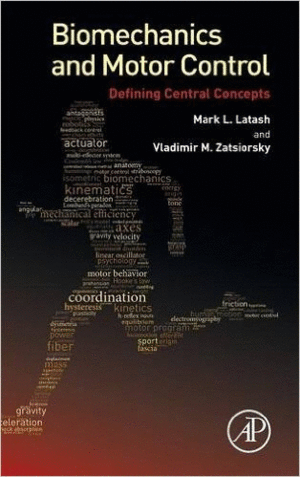
LATASH, M.L.; ZATSIORSKY, V.M.
Descuento:
-5%Antes:
Despues:
56,05 ۥ Part One. Biomechanical Concepts
1. Joint Torque
1.1. Elements of history
1.2. What are the joint torques/moments?
1.3. Joint moments in statics and dynamics
1.4. The bottom line
2. Stiffness and Stiffness-like Measures
2.1. Elements of history
2.2. The concept of stiffness
2.3. Elastic properties of muscles and tendons
2.4. Apparent stiffness of joints and kinematic chains
2.5. The bottom line
3. Velocity-Dependent Resistance
3.1. Viscosity in physics
3.2. Elements of history: muscle viscosity theory and its collapse
3.3. On muscle and joint viscosity—comments on the terminology
3.4. Velocity-dependent resistance of the passive objects—synovial fluid, tendons, passive muscles, and joints
3.5. Velocity-dependent resistance of the active objects—muscles, joints, kinematic chains
3.6. More on muscle viscosity
3.7. Mechanical impedance
3.8. A comment on clinical terminology
3.9. The bottom line
4. Mechanical Work and Energy
4.1. Elements of history
4.2. Definitions of work and power—work of a muscle
4.3. Work and power in human movements
4.4. Energy saving mechanisms
4.5. The bottom line
• Part Two. Neurophysiological Concepts
5. Muscle Tone
5.1. Elements of history
5.2. Current definitions
5.3. Relation of muscle tone to the tonic stretch reflex
5.4. Muscle tone and ability to relax
5.5. Factors causing “low muscle tone”
5.6. Factor causing “high muscle tone”
5.7. The bottom line
6. Reflexes
6.1. Elements of history
6.2. Current definitions of reflex
6.3. Preferred definition of reflex
6.4. Classifications of reflexes
6.5. Examples of commonly studied reflexes in humans
6.6. The role of reflexes in movements
6.7. Pathological reflexes
6.8. The bottom line
7. Preprogrammed Reactions
7.1. Elements of history
7.2. Current terminology
7.3. Definition and origins of preprogrammed reactions
7.4. Examples of commonly studied preprogrammed reactions
7.5. The role of preprogrammed reactions in movements
7.6. Atypical preprogrammed reactions
7.7. The bottom line
8. Efferent Copy
8.1. Elements of history
8.2. Current terminology
8.3. Kinesthetic perception
8.4. Efferent copy within a general scheme of motor control
8.5. The bottom line
9. Central Pattern Generator
9.1. Elements of history
9.2. Current terminology
9.3. Various CPGs
9.4. Cyclic versus discrete actions
9.5. The role of CPGs in movements
9.6. The bottom line
• Part Three. Motor Control Concepts
10. Redundancy and Abundance
10.1. Elements of history
10.2. Current terminology
10.3. Optimization
10.4. Optimal feedback control
10.5. Abundance in movements
10.6. Relations to everyday voluntary movements
10.7. The bottom line
11. Motor Synergy
11.1. Elements of history
11.2. Current terminology
11.3. Analysis of Synergy-C
11.4. Synergy-C: examples of synergies
11.5. Anticipatory synergy adjustments
11.6. Atypical synergies
11.7. Changes in synergies with practice
11.8. Origins of synergies
11.9. The bottom line
12. Equilibrium-Point Hypothesis
12.1. Elements of history
12.2. Current terminology
12.3. Control with threshold elements
12.4. Control of a single muscle
12.5. Control of a joint
12.6. Referent configuration hypothesis
12.7. Equifinality and its violations
12.8. Relation of the EP hypothesis to the notion of synergies
12.9. The bottom line
13. Motor Program
13.1. Elements of history
13.2. Current definitions for motor program
13.3. What can be encoded by signals from the brain?
13.4. Are there motor programs in the spinal cord?
13.5. Do neuronal populations in the brain generate motor programs?
13.6. Impaired motor programs
13.7. Are new motor programs created in the process of motor learning?
13.8. The bottom line
• Part Four. Examples of Motor Behaviors
14. Posture
14.1. Elements of history
14.2. Creating a definition for posture
14.3. Posture as a steady-state process: postural sway
14.4. Posture and movement: two outcomes of control with referent configurations
14.5. Postural synergies
14.6. Postural preparation to action
14.7. Posture-stabilizing mechanisms
14.8. The bottom line
15. Grasping
15.1. Elements of history
15.2. Basic mechanics of grasps
15.3. Basics of grasp control
15.4. Motor control constraints in hand and digit actions
15.5. Prehension synergies
15.6. The bottom line
• Glossary
• Index
Biomechanics and Motor Control: Defining Central Concepts provides a thorough update to the rapidly evolving fields of biomechanics of human motion and motor control with research published in biology, psychology, physics, medicine, physical therapy, robotics, and engineering consistently breaking new ground.
This book clarifies the meaning of the most frequently used terms, and consists of four parts, with part one covering biomechanical concepts, including joint torques, stiffness and stiffness-like measures, viscosity, damping and impedance, and mechanical work and energy. Other sections deal with neurophysiological concepts used in motor control, such as muscle tone, reflex, pre-programmed reactions, efferent copy, and central pattern generator, and central motor control concepts, including redundancy and abundance, synergy, equilibrium-point hypothesis, and motor program, and posture and prehension from the field of motor behavior.
The book is organized to cover smaller concepts within the context of larger concepts. For example, internal models are covered in the chapter on motor programs. Major concepts are not only defined, but given context as to how research came to use the term in this manner.
Key Features
• Presents a unified approach to an interdisciplinary, fragmented area
• Defines key terms for understanding
• Identifies key theories, concepts, and applications across theoretical perspectives
• Provides historical context for definitions and theory evolution
Authors
• Mark L. Latash, Department of Kinesiology, The Pennsylvania State University, University Park, PA, USA.
• Vladimir Zatsiorsky, Department of Kinesiology, The Pennsylvania State University, University Park, PA, USA
 -5%
-5%
 -5%
-5%
 -5%
-5%
 -5%
-5%
 -5%
-5%
 -5%
-5%
 -5%
-5%
 -5%
-5%
 -5%
-5%
 -5%
-5%