Descuento:
-5%Antes:
Despues:
98,11 ۥ UNIT I AGENTS IMMUNITY AND AGENCIES 5
1 Bacteria Toxins and Viruses 7
2 The Human Immune System 27
3 Defense Agencies 37
• UNIT I REVIEW 51
• UNIT II BACTERIA 53
4 Anthrax 55
5 Plague 75
6 Tularemia 91
7 Cholera 103
• UNIT II REVIEW 117
• UNIT III TOXINS 119
8 Ricin 121
9 Botulinum Toxin 135
10 Staphylococcal Enterotoxin B 151
• UNIT III REVIEW 161
• UNIT IV VIRUSES 163
11 Ebola 165
12 Smallpox 179
13 Hantavirus 199
14 Viral Encephalitis 211
15 Nipah Virus 221
16 Lassa Fever 231
17 Marburg Virus 243
• UNIT IV REVIEW 255
18 Looking Ahead: Policies Procedures and Prevention 259
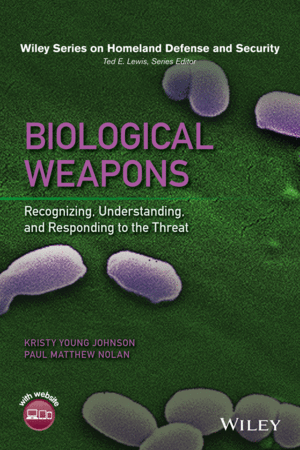
Gives readers a detailed understanding of how specific biological weapons work and how those affected by the weapons would be treated
• Teaches the reader to recognize the symptoms of each biological weapon and understand the threat these weapons pose
• Concentrates on the weapons considered the greatest threats by the CDC such as Anthrax, Botulism, Smallpox, Ricin toxin, Ebola, Plague, and Viral encephalitis
• Provides a detailed understanding of how specific biological weapons work and how to recognize the symptoms of those affected by the weapons as well as how they would be treated
• Includes case studies, chapter review questions, and the instructor’s supplemental materials include PowerPoint presentations, a Test Bank, and suggestions for student projects
• Begins with a primer on microbiology, the human immune system’s response to these biological agents, and the defense agencies involved with protecting the public against these agents
Author Information
• Kristy Young Johnson is an Associate Professor in the Department of Biology at The Citadel - The Military College of South Carolina. She has taught a wide variety of undergraduate and graduate biology courses, including General Biology, Genetics, Microbiology, and Descriptive Histology. She developed an entirely new Bioterrorism course that she has taught regularly since 2007. She holds a Bachelor of Science in Chemistry from Gardner-Webb University in North Carolina and a doctorate in Pathology and Laboratory Medicine from the Medical University of South Carolina.
• Paul Matthew Nolan is an Associate Professor of Biology, Behavior, and Disease Ecology at The Citadel - The Military College of South Carolina as well as an adjunct professor in the Graduate Program in Marine Biology, and Graduate Program in Environmental Studies at The College of Charleston. In 2012 he was awarded the Faculty Spotlight Award for Excellence in Teaching and Scholarship from The Citadel. He has published extensively on the influence of condition and parasites on individual condition in a wide variety of bird species.
 -5%
-5%
 -5%
-5%
 -5%
-5%
 -5%
-5%
 -5%
-5%
 -5%
-5%
 -5%
-5%
 -5%
-5%
 -5%
-5%
 -5%
-5%