Descuento:
-5%Antes:
Despues:
108,30 €• Fixed prosthodontics—clinical vs pre-clinical practice
• Degradation of dental implant systems after immersion in therapeutic gels
• Novel strategies for the enhancement of zirconia behavior
• Surface finishing in tooth preparation for fixed prosthodontics—comparative study
• Virtual die-spacing—Everest® (Kavo®) system evaluation
• Implant Stability Quotient (ISQ) from surgery to prosthetic rehabilitation
• A 2D stress analysis of zirconia dental implants: A comparison study
• Meshless methods in oral biomechanics
• Stress analysis of 3D trabecular patches: A computational study
• Micro-CT images for mechanical simulation geometrical models using advanced discretisation techniques
• Development of a computational framework to predict bone tissue remodelling using distinct discretization techniques
• Endodontic-periodontal lesions: A 2D computational study
• The numerical analysis of angled abutments using advanced discretization techniques
• Surface roughness of stainless steel orthodontic loops in artificial saliva
• Surface changes (scanning electron microscope) induced by artificial saliva in stainless steel orthodontic loops
• Convergence angle of prepared teeth for full crowns
• Dermal zygomatic peri-implant reaction—gene expression?
• Palatal obturators for cleft palate patients
• Linkage between denture’s conditions and oral lesions
• Influence of selective etching on marginal filtration of self-etching adhesives
• Mandible anomalies—how can two-dimensional ultrasound help?
• Influence of porosity and cell density on tissue engineering of mandibular condylar cartilage
• Effects of dynamic compression on cells in tissue engineering of mandibular condylar cartilage
• Three-dimensional scaffold in bone regeneration
• Experimental study of a new biomembrane (MES) for guided bone regeneration
• Image processing techniques and orthodontic related apical root resorption prediction models
• Effect of drill speed on bone damage during drilling
• Determination of optimal parameters in drilling composite materials to minimize the machining temperature using the Taguchi method
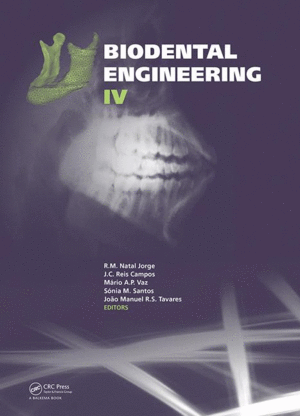
Since dentistry is a branch of medicine with its own peculiarities and very diverse areas of action, it can be considered as an interdisciplinary field. BIODENTAL ENGINEERING IV contains the full papers presented at the 4th International Conference on Biodental Engineering (BIODENTAL 2016, Vila Nova de Famalicão, Portugal, 21—23 June 2016), and covers the use of new techniques and technologies in dentistry.
The contributions provide a comprehensive coverage of the state-of-the art in this area, and addresses the following topics:
• Aesthetics
• Bioengineering
• Biomaterials
• Biomechanical disorders
• Biomedical devices
• Computational bio- imaging and visualization
• Computational methods
• Dental medicine
• Experimental mechanics
• Signal processing and analysis
• Implantology
• Minimally invasive devices and techniques
• Orthodontics
• Prosthesis and orthosis
• Simulation
• Software development
• Telemedicine
• Tissue engineering
• Virtual reality
BIODENTAL ENGINEERING IV will be of interest to academics and professionals involved or interested in dentistry, biomechanical disorders, numerical simulation, orthodontics, implantology, aesthetics, dental medicine, medical devices and medical imaging.
Authors
Editor(s) Bio
• Renato Natal Jorge is Associate Professor at the Department of Mechanical Engineering at the University of Porto, Portugal.
• José Carlos Reis Campos is Associate Professor at the Department of Mining Engineering at the University of Porto, Portugal.
• Mário Augusto Pires Vaz is Associate Professor at the Department of Mechanical Engineering at the University of Porto, Portugal.
• Sonia Santos works at Med Support - Engenharia & Apoio à Decisão, Ltd., Maia, Porto, Portugal.
• João Manuel Tavares is Associate Professor at the Department of Mechanical Engineering at the University of Porto, Portugal.
 -5%
-5%
 -5%
-5%
 -5%
-5%
 -5%
-5%
 -5%
-5%
 -5%
-5%
 -5%
-5%
 -5%
-5%
 -5%
-5%
 -5%
-5%