Descuento:
-5%Antes:
Despues:
167,95 €Section I: Conventional Laparoscopy
Basic Principles and Anatomy for the Laparoscopic Surgeon
Laparoscopic Myomectomy
Laparoscopic Adnexal Surgery
Laparoscopic Total and Supracervical Hysterectomy
Laparoscopic Excision of Endometriosis
Techniques in Gynecologic Oncology
Techniques in Urogynecology and Pelvic Reconstructive Surgery
Techniques in Reproductive Surgery
Section II: Single/Reduced Laparoscopy9
Instrumentation for Single-Site Gynecologic Surgery Single-Port Laparoscopic Adnexal Surgery
Single-Port Laparoscopic Hysterectomy
Single-Port Laparoscopic Management of Endometriosis Techniques for Single-Port Gynecologic Oncology
Techniques for Single-Port Urogynecology and Pelvic Reconstructive Surgery
Section III: Robotic Surgery15
Instrumentation, Platforms, and Basic Principles Robotics
Robotic- Assisted Laparoscopic Myomectomy
Robotic-Assisted Total Laparoscopic Hysterectomy
Robotic-Assisted Management of Endometriosis
Robotic Surgery in Gynecologic Oncology
Techniques for Robotic Urogynecology and Pelvic Reconstructive Surgery
Techniques for Robotic Tubal Surgery
Management of Laparoscopy-Related Complications Single-Port Robotics
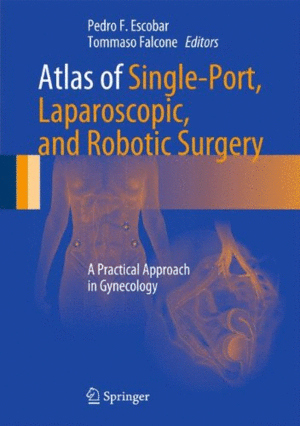
Minimally invasive surgery has become the standard treatment for many diseases and conditions. In the last decade, numerous studies have demonstrated that laparoscopic approaches have improved patients’ quality of life if compared with standard open procedures. Laparoendoscopic single-site surgery (LESS), also known as single-port surgery, has been recently developed as an alternative to conventional laparoscopy or robotic surgery and as an attempt to further enhance the cosmetic benefits of minimally invasive surgery, while minimizing the potential morbidity associated with multiple incisions. This surgical atlas serves as guide in single-port, standard laparoscopy, and robotic surgery and shows how novel techniques, such as single-port laparoscopy and robotics, have recently evolved; the atlas illustrates the unique challenges that the new single-port surgery modality presents, including instruments crowding and articulation, and the advanced laparoscopic skills required to perform these procedures, such as the ability to move and control a flexible camera. This exceptional resource provides students, residents, fellows, operating room personnel, and practicing gynecologic surgeons with invaluable information about instrumentation, surgical technique, port systems, and the current research and development in single-port robotics.
Features
• A unique and helpful resource for Gynecologic surgeons, OB/GYNs, Gynecologic Oncologists, and Reproductive Endocrinologists
• Illustrates ways to overcome common challenges such as instrument crowding, lack of triangulation, and loss of depth of perception and instability with current 2D flexible optics
• Conveniently organized in three sections: Laparoscopy, Single-Reduced Laparoscopy, Robotic-Assisted Laparoscopy
Authors
• Tommaso Falcone, MD, FRCS(C), FACOG, is Professor of Surgery at Cleveland Clinic Lerner College of Medicine of Case Western Reserve University and Chairman of the Department of Obstetrics-Gynecology at Cleveland Clinic. He is certified by the American Board of Obstetrics and Gynecology in general obstetrics and gynecology, as well as reproductive endocrinology. He is also certified by the Royal College of Physicians and Surgeons of Canada. Dr. Falcone serves on the editorial board and is an ad hoc reviewer of more than 21 journals, most notably Fertility & Sterility and Obstetrics & Gynecology. He has been on the Board of Directors of several societies. Dr. Falcone is past president of the Society for Reproductive Surgeons and has served on review committees for NICHD and MRC. He is also an oral examiner for the American Board of Obstetrics & Gynecology.
• Pedro F. Escobar, MD, is a Staff Physician in the Department of Obstetrics/Gynecology and Women's Institute at Cleveland Clinic. He is also an Assistant Professor of Surgery for the Cleveland Clinic Lerner College of Medicine of Case Western University in Cleveland, Ohio. Dr. Escobar specializes in the surgical and chemotherapy management of women with gynecologic cancers. His clinical interests include single port surgery and robotic surgery.
 -5%
-5%
 -5%
-5%
 -5%
-5%
 -5%
-5%
 -5%
-5%
 -5%
-5%
 -5%
-5%
 -5%
-5%
 -5%
-5%
 -5%
-5%