Descuento:
-5%Antes:
Despues:
79,04 €1. Defining the Evolving Concept of Impairment
2. The Role of Family and Cross-Setting Supports to Reduce Impairment and Promote Success
3. Relationships Between Adaptive Behavior and Impairment
4. Impairment in Children
5. Impairment in the Geriatric Population
6. Legal Conceptions of Impairment: Implications for the Assessment of Psychiatric Disabilities
7. The Medical Model of Impairment
8. The Diagnostic and Statistical Manual of Mental Disorders: Fifth Edition (DSM-5) Model of Impairment
9. Impairment in Parenting
10. Psychometric Issues in the Assessment of Impairment
11. Measurement of Symptom Severity and Impairment
12. Measuring Impairment with the Rating Scale of Impairment
13. Measuring Impairment with the Barkley Functional Impairment Scales
14. Measuring Impairment with the Neuropsychological Impairment Scale
15. Assessing Occupational Disability Following Trauma and Impairment
16. Treatment Integrity in Interventions for Children Diagnosed with DSM-5 Disorders
17. Conclusions
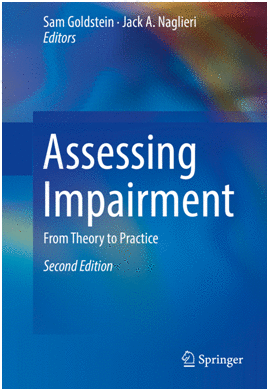
This Second Edition of the book expands on the in-depth treatment of the theory, definition, and evaluation of impairment presented in the original volume. It explores the complex relationships between disabling conditions and impairment, with new data and insights on assessment and potential avenues for treatment. Original and revised chapters critique current models of impairment and offers an integrated model rooted in the contexts of medical, mental health, and cognitive challenges in disability. Leading scholars and clinicians provide updated evidence for a much-needed reconceptualization of impairment within the context of diagnosis and disability. This contextual approach to assessment – a wide-ranging quality-of life perspective – goes beyond symptom counting, resulting in more accurate diagnosis, targeted interventions, and improved patient functioning.
Topics featured in this book include:
• The role of family and cross-setting supports in reducing impairment.
• Relationships between adaptive behavior and impairment.
• Legal conceptions of impairment and its implications for the assessment of psychiatric disabilities.
• Impairment in parenting.
• The Neuropsychological Impairment Scale (NIS).
• The Barkley Functional Impairment Scale (BFIS).
• The Rating Scale of Impairment (RSI).
• Treatment integrity in interventions for children diagnosed with DSM-5 disorders.
Assessing Impairment, Second Edition, is a must-have resource for researchers, clinicians, professionals, and graduate students in clinical child, school, and developmental psychology as well as child and adolescent psychiatry, educational psychology, rehabilitation medicine/therapy, social work, and pediatrics.
Features
• Expands and updates First Edition’s analysis of theory and research on impairment
• Addresses improved diagnoses, interventions, and patient functioning according to DSM-5 and other medical models
• Explores issues of resilience, adaptive behaviors, and treatment integrity
• Examines impairment across broad domains of physical, educational, and cognitive disabilities
• A must-have companion to the Impairment Rating Scale
 -5%
-5%
 -5%
-5%
 -5%
-5%
 -5%
-5%
 -5%
-5%
 -5%
-5%
 -5%
-5%
 -5%
-5%
 -5%
-5%
 -5%
-5%
 -5%
-5%