Descuento:
-5%Antes:
Despues:
98,79 €1. Acetazolamide
2. Brivaracetam
3. Carbamazepine
4. Clobazam
5. Clonazepam
6. Eslicarbazepine Acetate
7. Ethosuximide
8. Felbamate
9. Gabapentin
10. Lacosamide
11. Lamotrigine
12. Levetiracetam
13. Methsuximide
14. Oxcarbazepine
15. Perampanel
16. Phenobarbital
17. Phenytoin
18. Piracetam
19. Pregabalin
20. Primidone
21. Retigabine
22. Rufinamide
23. Stiripentol
24. Sulthiame
25. Tiagabine
26. Topiramate
27. Valproic Acid
28. Vigabatrin
29. Zonisamide
30. Acetazolamide
31. Brivaracetam
32. Carbamazepine
33. Clobazam
34. Clonazepam
35. Eslicarbazepine Acetate
36. Ethosuximide
37. Felbamate
38. Gabapentin
39. Lacosamide
40. Lamotrigine
41. Levetiracetam
42. Methsuximide
43. Oxcarbazepine
44. Perampanel
45. Phenobarbital
46. Phenytoin
47. Piracetam
48. Pregabalin
49. Primidone
50. Retigabine
51. Rufinamide
52. Stiripentol
53. Sulthiame
54. Tiagabine
55. Topiramate
56. Valproic Acid
57. Vigabatrin
58. Zonisamide
59. Analgesics
60. Antimicrobials
61. Antineoplastic Agents
62. Antiulcer Drugs
63. Cardiovascular Drugs
64. Immunosuppressants
65. Neuromuscular Blocking Agents
66. Psychotropic Drugs
67. Steroids
68. Miscellanea
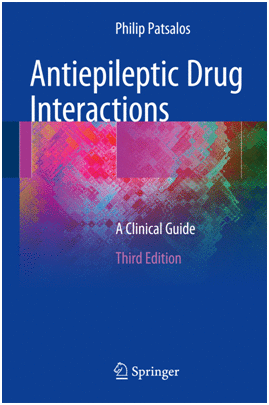
This updated third edition of a successful book is a description of both pharmacokinetic and pharmacodynamic antiepileptic drug (AED) interactions, including details of the magnitude and mechanism of interactions, and also of drug combinations that are not associated with interactions and therefore can be coprescribed without undue concern. Presented in alphabetical order and by drug class, drug interactions that occur between AEDs and also between AEDs and non-AEDs are described in three sections: Drug interactions between AEDs; Drug interactions between AEDs and non-AED Drugs: Interactions affecting AEDs; Drug interactions between AEDs and non-AED Drugs: Interactions affected by AEDs.
Antiepileptic Drug Interactions: A Clinical Guide, 3rd Edition with its clear, concise and unambiguous content will allow physicians and allied health professionals to make more rational choices when AED polytherapy regimens are indicated. There is always a choice and avoiding highly interacting drugs and choosing drug combinations that are minimally interacting or do not interact should be the goal in treating patients with epilepsy. This book provides all the necessary information so as to allow this goal to be achieved and, if necessary, to aid effective management of AED interactions.
Features
• Covers all clinically licensed AEDs, including those licensed only in specific countries or that have limited indications
• Highlights the way AED interactions occur in three separate sections
• Includes details of the mechanism and magnitude of the interaction between drugs
• Both pharmacokinetic and pharmacodynamic interactions are described
• Includes AED combinations that are not associated with interactions
• Now includes sections on recently licensed AEDs perampanel and brivaracetam
Author
Philip N. Patsalos, FRCPath, PhD. Professor of Clinical Pharmacology/Consultant Clinical Pharmacologist. Institute of Neurology/The National Hospital for Neurology and Neurosurgery, Queen Square, London and the Epilepsy Society, Chalfont St Peter, UK
 -5%
-5%
 -5%
-5%
 -5%
-5%
 -5%
-5%
 -5%
-5%
 -5%
-5%
 -5%
-5%
 -5%
-5%
 -5%
-5%
 -5%
-5%