Descuento:
-5%Antes:
Despues:
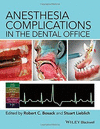
87,13 €Anesthetic complications, which range from simple annoyances to patient mortality, are inevitable, given the many and complex interactions of doctor, patient, personnel, and facility. Anesthesia Complications in the Dental Office helps dentists minimize the frequency and severity of adverse events by providing concise and clinically relevant information that can be put to everyday use.
Anesthesia Complications in the Dental Office presents the most up-to-date information on treating anesthesia complications and medical emergencies. Drs. Bosack and Lieblich and a team of expert contributors discuss patient risk assessment; considerations for special needs and medically compromised patients; routinely administered anesthetic agents; adversities that can arise before, during, and after administration of anesthesia; and emergency drugs and equipment. A must-have reference for every dental office.
Author Information
Robert C. Bosack, DDS, is an oral and maxillofacial surgeon and clinical assistant professor at the University of Illinois College of Dentistry. He has served as an examiner for the American Board of Oral and Maxillofacial Surgery, and has served on the board of directors of the National Dental Board of Anesthesiology. He is the executive director of Dental Anesthesia Online. Dr. Bosack speaks at national dental and anesthesia conferences and has written professional articles and the book Medical Emergencies in the Dental Office. He maintains a private practice in Orland Park, Illinois.
Stuart Lieblich, DMD, is clinical professor in the Division of Oral and Maxillofacial Surgery at the University of Connecticut School of Dental Medicine. He is a Past President of the American Dental Society of Anesthesiology and a past Director of the American Board of Oral and Maxillofacial Surgery. He serves on the editorial board of 3 major journals, has written more than 20 textbook chapters, and is an invited speaker at national conferences. Dr. Lieblich maintains a private practice in Avon, Connecticut.
Table of Contents
Section 1: Introduction
1 Anesthetic complications—how bad things happen 3
Section 2: Patient risk assessment
2 History and physical evaluation 9
3 Laboratory evaluation 15
4 NPO guidelines 19
Section 3: Anesthetic considerations for special patients
5 Anesthetic considerations for patients with cardiovascular disease 25
6 Anesthetic considerations for patients with respiratory disease 49
7 Anesthetic considerations for patients with endocrinopathies 61
8 Anesthetic considerations for patients with psychiatric illness 71
9 Anesthetic considerations for patients with neurologic disease 79
10 Anesthetic considerations for patients with hepatic disease 85
11 Anesthetic considerations for patients with renal disease 89
12 Anesthetic considerations for pediatric patients 93
13 Anesthetic considerations for geriatric patients 97
14 Anesthetic considerations for patients with bleeding disorders 103
15 Anesthetic considerations for patients with cancer 113
16 Anesthetic considerations for pregnant and early postpartum patients 117
Section 4: Review of anesthetic agents
17 Clinical principles of anesthetic pharmacology 123
18 Local anesthetic pharmacology 129
19 Enteral sedation agents 133
20 Parenteral anesthetic agents 135
21 Inhalational anesthetic agents 143
22 Antimuscarinics and antihistamines 151
23 Drug interactions 155
Section 5: Monitoring
24 Limitations of patient monitoring during office-based anesthesia 163
Section 6: Preparation for adversity
25 Crisis resource management 173
26 Simulation in dental anesthesia 177
27 Airway adjuncts 181
28 Intravenous fluids 185
29 Emergency drugs 189
Section 7: Anesthetic adversity
30 Failed sedation 201
31 Complications with the use of local anesthetics 207
32 Anesthetic adversity – cardiovascular problems 219
33 Anesthetic adversity—respiratory problems 231
34 Allergy and anaphylaxis 251
35 Anesthetic adversity–neurologic problems 257
36 Acute adverse cognitive behavioral and neuromuscular changes 261
37 Anesthetic problems involving vasculature 271
Section 8: Post-anesthetic adversity
38 Nausea and vomiting 277
39 Post-anesthetic recall of intraoperative awareness 283
40 Delayed awakening from anesthesia 287
41 Safe discharge after office-based anesthesia 291
Section 9: When bad things happen
42 Morbidity and mortality 295
43 Death in the chair: a dentist’s nightmare 299
44 Legal issues of anesthesia complications: risks or malpractice 307
Section 10: When should you say no
45 When should you say no? 315
Section 11: Appendices
Appendix A A pilot’s perspective on crisis resource management 323
Appendix B Medical emergency manual for the general practitioner 325
Appendix C Malignant hyperthermia Q & A 337
Index 339
 -5%
-5%
 -5%
-5%
 -5%
-5%
 -5%
-5%
 -5%
-5%
 -5%
-5%
 -5%
-5%
 -5%
-5%
 -5%
-5%
 -5%
-5%