Descuento:
-5%Antes:
Despues:
79,80 ۥ TOPOLOGY
Sets, Numbers, Cardinals, and Ordinals
Sets and Numbers
Sets and Cardinal Numbers
Axiom of Choice and Equivalent Statements
• Metric Spaces: Definition, Examples, and Basics
Metric Spaces: Definition and Examples
Metric Spaces: Basics
• Topological Spaces: Definition and Examples
The Definition and Some Simple Examples
Some Basic Notions
Bases
Dense and Nowhere Dense Sets
Continuous Mappings
• Subspaces, Quotient Spaces, Manifolds, and CW-Complexes
Subspaces
Quotient Spaces
The Gluing Lemma, Topological Sums, and Some Special Quotient Spaces
Manifolds and CW-Complexes
• Products of Spaces
Finite Products of Spaces
Infinite Products of Spaces
Box Topology
• Connected Spaces and Path Connected Spaces
Connected Spaces: Definition and Basic Facts
Properties of Connected Spaces
Path Connected Spaces
Path Connected Spaces: More Properties and Related Matters
Locally Connected and Locally Path Connected Spaces
• Compactness and Related Matters
Compact Spaces: Definition
Properties of Compact Spaces
Compact, Lindelöf, and Countably Compact Spaces
Bolzano, Weierstrass, and Lebesgue
Compactification
Infinite Products of Spaces and Tychonoff Theorem
• Separation Properties
The Hierarchy of Separation Properties
Regular Spaces and Normal Spaces
Normal Spaces and Subspaces
• Urysohn, Tietze, and Stone-Cech
Urysohn Lemma
The Tietze Extension Theorem
Stone-Cech Compactification
• HOMOTOPY
Isotopy and Homotopy
Isotopy and Ambient Isotopy
Homotopy
Homotopy and Paths
The Fundamental Group of a Space
• The Fundamental Group of a Circle and Applications
The Fundamental Group of a Circle
Brouwer Fixed Point Theorem and the Fundamental Theorem of Algebra
The Jordan Curve Theorem
• Combinatorial Group Theory
Group Presentations
Free Groups, Tietze, Dehn
Free Products and Free Products with Amalgamation
• Seifert–van Kampen Theorem and Applications
Seifert–van Kampen Theorem
Seifert–van Kampen Theorem: Examples
The Seifert–van Kampen Theorem and Knots
Torus Knots and Alexander’s Horned Sphere
Links
• On Classifying Manifolds and Related Topics
1-Manifolds
Compact 2-Manifolds: Preliminary Results
Compact 2-Manifolds: Classification
Regarding Classification of CW-Complexes and Higher Dimensional Manifolds
Higher Homotopy Groups: A Brief Overview
• Covering Spaces, Part 1
Covering Spaces: Definition, Examples, and Preliminaries
Lifts of Paths
Lifts of Mappings
Covering Spaces and Homotopy
• Covering Spaces, Part 2
Covering Spaces and Sheets
Covering Trans formations
Covering Spaces and Groups Acting Properly Discontinuously
Covering Spaces: Existence
The Borsuk–Ulam Theorem
• Applications in Group Theory
Cayley Graphs and Covering Spaces
Topographs and Presentations
Subgroups of Free Groups
Two Subgroup Theorems
• Bibliography
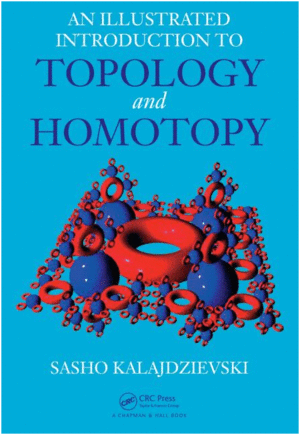
An Illustrated Introduction to Topology and Homotopy explores the beauty of topology and homotopy theory in a direct and engaging manner while illustrating the power of the theory through many, often surprising, applications. This self-contained book takes a visual and rigorous approach that incorporates both extensive illustrations and full proofs.
The first part of the text covers basic topology, ranging from metric spaces and the axioms of topology through subspaces, product spaces, connectedness, compactness, and separation axioms to Urysohn’s lemma, Tietze’s theorems, and Stone-Cech compactification. Focusing on homotopy, the second part starts with the notions of ambient isotopy, homotopy, and the fundamental group. The book then covers basic combinatorial group theory, the Seifert-van Kampen theorem, knots, and low-dimensional manifolds. The last three chapters discuss the theory of covering spaces, the Borsuk-Ulam theorem, and applications in group theory, including various subgroup theorems.
Requiring only some familiarity with group theory, the text includes a large number of figures as well as various examples that show how the theory can be applied. Each section starts with brief historical notes that trace the growth of the subject and ends with a set of exercises.
Features
• Provides a comprehensive treatment of basic topology and homotopy that uses a combination of rigorous proofs and extensive visualization
• Gives full details of most proofs
• Contains nearly 600 figures that help clarify difficult concepts
• Presents historical notes that outline the growth of the subject
• Includes about 750 exercises, many of which are relatively new
• Offers figures for each chapter on the author’s website
Forthcoming solutions manual available upon qualifying course adoption
 -5%
-5%
 -5%
-5%
 -5%
-5%
 -5%
-5%
 -5%
-5%
 -5%
-5%
 -5%
-5%
 -5%
-5%
 -5%
-5%
 -5%
-5%