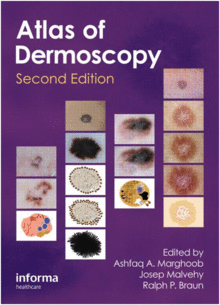
MARGHOOB, A.; BRAUN, R.; MALVEHY, J.; KOPF, A.
Descuento:
-5%Antes:
Despues:
270,20 €- Discusses differences in dermoscopic criteria depending on anatomical location and computer-assisted diagnosis
- Stresses the dermoscopist's role in prevention and early detection
- Explores the latest uses for dermoscopy, including diagnosing scabies, evaluating paranychial capillaries, and observing vascular aspects of cutaneous diseases
- Covers important melanocytic, non-melanocytic, benign, and malignant pigmented skin lesions
- Contains more than 1,500 figures, tables, and schematics
Summary
Building on a successful first edition, this revised and extended Atlas of Dermoscopy demonstrates the state of the art of how to use dermoscopy to detect and diagnose lesions of the skin, with a special emphasis on malignant skin tumours. With well over 1,500 photographs, drawings, and tables, the book has extensive clinical correlation with dermoscopic images, so readers can appreciate the added benefits of dermoscopy by comparing the clinical morphology seen with the naked eye with the corresponding dermoscopic morphology; extensive illustrations from the image collections of internationally recognized experts, who have years of experience refining their techniques; and extensive schematic drawings to help readers single out the key structures and patterns to recognize in the dermoscopic images.
The second edition has important new material on such topics as observed differences between polarized and non-polarized dermoscopy, newly recognized structures and patterns, refined and revised suggestions for pattern analysis, dermoscopy of the hair and nails, and how to integrate dermoscopy into general clinical practice. It also covers dermoscopically equivocal, false negative, and false positive lesions; discusses further indications for dermoscopy beyond skin cancer; and details common checklists of criteria and algorithms used to diagnose skin lesions.
Authors
- Ashfaq Marghoob: Director of Memorial Sloan-Kettering Cancer Center’s regional skin cancer clinic in Hauppauge, Long Island, USA.
- Ralph Braun: Department of Dermatology, University of Zurich, Switzerland.
- Josep Malvehy: Director, Melanoma Unit, University Hospital Clinic, Barcelona, Spain. Board member of International Dermoscopy Society.
CONTENTS:
1. Introduction
2. Principles of dermoscopy and equipment
3. Tissue correlations of dermoscopic structures
4. Differential diagnosis: the 2-step method
5. Non-melanocytic lesions
6. Step 2: differentiating between melanoma maligna and benign melanocytic nevi
7. Benign melanocytic lesions
8. Melanoma
9. Special locations
10. Exceptions to the 2-step method
11. Dermoscopy in general dermatology
12. Vascular structures as indications of diagnosis
13. Diagnostic accuracy and confidence
14, Follow-up and pitfalls in follow-up
15. Conclusions: dermoscopy in clinical practice
16. Test cases
17. References and resources
 -5%
-5%
 -5%
-5%
 -5%
-5%
 -5%
-5%
 -5%
-5%
 -5%
-5%
 -5%
-5%
 -5%
-5%
 -5%
-5%
 -5%
-5%