Descuento:
-5%Antes:
Despues:
127,45 ۥ Dedication
• List of Contributors
• About the Author
• Foreword
• Preface
• Chapter 1: Amphioxus as a Model for Understanding the Evolution of Vertebrates
o Abstract
o 1.1. Brief introduction of amphioxus
o 1.2. Biology of amphioxus
o 1.3. The story of amphioxus and early research studies in China
• Chapter 2: Basic Knowledge of Immunology
o Abstract
o 2.1. Immune organs
o 2.2. Immune cells
o 2.3. Innate immunity
o 2.4. Adaptive immunity
o 2.5. Complement system
• Chapter 3: Immune Organs and Cells of Amphioxus
o Abstract
o 3.1. Introduction
o 3.2. Organs of the amphioxus immune system
o 3.3. Cells of the amphioxus immune system
• Chapter 4: Genomic and Transcriptomic View of Amphioxus Immunity
o Abstract
o 4.1. Introduction
o 4.2. Trace evidence of adaptive immunity
o 4.3. Extraordinary gene expansion in amphioxus innate immunity
o 4.4. Regulation of the amphioxus immune system
o 4.5. Discussion
• Chapter 5: Pattern Recognition System in Amphioxus
o Abstract
o 5.1. TLR signaling pathway in amphioxus
o 5.2. Innate antiviral immunity in amphioxus
o 5.3. NLR signaling pathway
• Chapter 6: Transcription Factors in Amphioxus
o Abstract
o 6.1. NF-?B family members in amphioxus
o 6.2. The interferon regulatory factor family in amphioxus
o 6.3. The STATs in amphioxus
• Chapter 7: The Complement System of Amphioxus
o Abstract
o 7.1. Introduction
o 7.2. Tracing the evolutionary origin of the complement system
o 7.3. The complement system of amphioxus
• Chapter 8: The Oxidative Burst System in Amphioxus
o Abstract
o 8.1. Introduction
o 8.2. NADPH oxidase 2 and the other NOX families
o 8.3. NOX subunits and regulatory proteins
o 8.4. Functions of ROS generated by NADPH oxidases
o 8.5. Phagocytic respiratory burst (PRB) appears to couple with phagocytosis in the amphioxus gut epithelial lining cells
• Chapter 9: Immune Effectors in Amphioxus
o Abstract
o 9.1. Galectin
o 9.2. C-type lectin
o 9.3. Peptidoglycan recognition protein
o 9.4. Gram-negative bacteria-binding protein
o 9.5. Chitin-binding protein
o 9.6. Apextrin-like protein
o 9.7. Bactericidal/permeability-increasing protein
o 9.8. Other effector genes
• Chapter 10: Evolution of Inflammation-Related Lipid Metabolism Pathway and Inflammatory Lipid Signaling in Amphioxus
o Abstract
o 10.1. Introduction
o 10.2. The classification, structure, and function of fatty acids and eicosanoids
o 10.3. Origin of vertebrate eicosanoid production
• Chapter 11: Apoptosis in Amphioxus
o Abstract
o 11.1. Apoptosis in mammals
o 11.2. Apoptosis-related gene families in amphioxus
• Chapter 12: Primitive Adaptive Immune System of Amphioxus
o Abstract
o 12.1. Evidence of the emergence of adaptive immunity in amphioxus
o 12.2. The primary building blocks for MHC and Rag protein
o 12.3. Alternative forms of variable immune receptors
o 12.4. Closing remark
• Chapter 13: Future Research Directions
o Abstract
o 13.1. Ubiquitination of immune signaling in amphioxus
o 13.2. The microRNAs in amphioxus
o 13.3. Alternative 3’ UTRs in the amphioxus immune response
• Abbreviation Index
• Subject Index
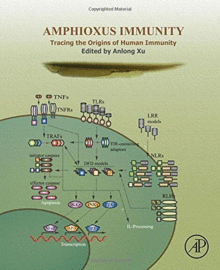
Amphioxus Immunity: Tracing the Origin of Human Immunity covers a remarkable range of information about Amphioxus and its evolutionary context.
This compilation of what is currently known about Amphioxus, with a sharp focus on its immune system, includes 13 topics, such as:
• Amphioxus as a model for understanding the evolution of vertebrates
• basic knowledge of immunology
• immune organs and cells of amphioxus
• a genomic and transcriptomic view of the Amphioxus immunity
• pattern recognition system in Amphioxus
• transcription factors in Amphioxus
• the complement system of Amphioxus
• the oxidative burst system in Amphioxus
• immune effectors in Amphioxus
• lipid signaling of immune response in Amphioxus
• apoptosis in amphioxus; primitive adaptive immune system of Amphioxus
• and future research directions.
This valuable reference book is loaded with information that will be useful for anyone who wishes to learn more about the origin of vertebrates and adaptive immunity.
KEY FEATURES
• Provides new evidence on the origin of the adaptive immune system, the evolution of innate immunity, and evolution-stage specific immune defense mechanisms
• Not only presents the cells and molecules involved in the adaptive immune response in Amphioxus, but also characterizes the origination and evolution of the gene families and pathways involved in innate immunity
• Includes much pioneering work, from the molecular, genomic, and cellular to the individual level.
Author
An-Long Xu, Professor, College of Life Sciences, Sun Yat-sen University, Guangzhou, China; President, Beijing University of Chinese Medicine
 -5%
-5%
 -5%
-5%
 -5%
-5%
 -5%
-5%
 -5%
-5%
 -5%
-5%
 -5%
-5%
 -5%
-5%
 -5%
-5%
 -5%
-5%