Descuento:
-5%Antes:
Despues:
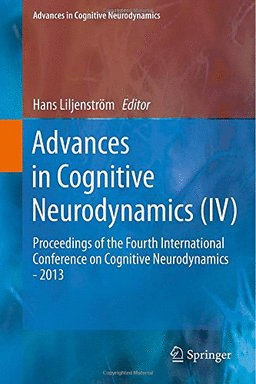
167,96 €This volume is the proceedings of the 4th International Conference on Cognitive Neurodynamics (ICCN2013) held in Sweden in 2013. The included papers reflect the large span of research presented and are grouped in ten parts that are organized essentially in a top-down structure. The first parts deal with social/interactive (I) and mental (II) aspects of brain functions and their relation to perception and cognition (III). Next, more specific aspects of sensory systems (IV) and neural network dynamics of brain functions (V), including the effects of oscillations, synchronization and synaptic plasticity (VI), are addressed, followed by papers particularly emphasizing the use of neural computation and information processing (VII). With the next two parts, the levels of cellular and intracellular processes (VIII) and finally quantum effects (IX) are reached. The last part (X) is devoted to the contributions invited by the Dynamic Brain Forum (DBF), which was co-organized with ICCN2013.
Table of contents (88 chapters)
1.Brain Network Efficiency and Intelligent Scores of Children
2.Computational Emotions
3.Group Neurodynamics: Conceptual and Experimental Framework
4.The Activity Modalities: A Priori Categories of Coordination
5.On the Use of Cognitive Neuroscience in Industrial Applications by Using Neuroelectromagnetic Recordings
6.A Study of c-VEP/SSVEP BCI Hybrid System
7.Memory Consolidation from Seconds to Weeks Through Autonomous Reinstatement Dynamics in a Three-Stage Neural Network Model
8.Biologically Inspired Models of Decision Making
9.Decision Making Mechanisms Based on Fundamental Principles of Thermodynamics
10.Reward Prediction in Prefrontal Cortex and Striatum
11.The Integrated Neuropsychiatric Assessment System: A Generic Platform for Cognitive Neurodynamics Research
12.An Interaction Between Orbitofrontal and Rhinal Cortices Contributing to Reward Seeking Behavior
13.Exploring Dynamic Temporal-Topological Structure of Brain Network Within ADHD
14.Study on the EEG Rhythm in Meditation
15.Set-Related Neurocognitive Networks
16.The Dissipative Many-Body Model and Phase Transitions in Brain Nonlinear Dynamics
17.Advanced Models of Cortical Dynamics in Perception
18.Modeling Cortical Singularities During the Cognitive Cycle Using Random Graph Theory
19.Concept Cells in the Human Brain
20.EEG Spatiotemporal Pattern Classification of the Stimuli on Different Fingers
21.Time Varying VEP Evaluation as a Prediction of Vision Fatigue Using Stimulated Brain-Computer Interface
22.Spike Synchronization Analysis in a Network Model of the Olfactory Bulb
23.Laterality of Gamma-Oscillations in Primate Supplementary Motor Area During Performance of Visually-Guided Movements
24.Thalamocortical and Intracortical Contributions to Task-Related Cross-Frequency Coupling in Auditory Cortex
25.Temporal Characteristics of the Steady State Visual Evoked Potentials
26.A Novel Neural Coding Mechanism Study of Interaural Time Difference Detection
27.Representation-Implementation Trade-Off in Cortico-Limbic Ganglio-Basal Loops
28.Source Differences in ERP Components Between Pain and Tactile Processing
29.The Time-Varying Causal Coupling in Brain and Organization of Its Networks
30.Enhancement of Weak Signal Detection in Parallel Arrays of Integrate-and-Fire Neurons by Negative Spatial Correlation
31.A Computational Model of Hippocampal-VTA Microcircuit: Why Expectation of Reward in Rat Striatum at Choice Point Is Covert?
32.A Computational Model of Cortical Pathways Formed with Electroencephalogram Synchronization
33.Neurodynamics of Up and Down Transitions in a Network Model
34.STDP Produces Well Behaved Oscillations and Synchrony
35.Robust Synchronization in Excitatory Networks with Medium Synaptic Delay
36.Synchronization in Neuronal Population with Phase Response
37.Geometry of Dynamic Movement Primitives in Neural Space: A FORCE-Learning Approach
38.Contribution of Endogeus Acetylcholine to STDP Induction
39.Bidirectional Wave Propagations Can Improve Loop Finding Time
40.Phase Coupling Between Hippocampal CA1 and Prefrontal Cortex in a Depression-Model Rats Indicating Impaired Synaptic Plasticity
41.Mapping of Cortical Avalanches to the Striatum
42.Gauss-Markov Processes for Neuronal Models Including Reversal Potentials
43.On Super-Turing Neural Computation
44.Chasing Cognitive Neurodynamics by Single-Trial Analysis of Electroencephalogram (EEG)
45.Brain: Biological Noise-Based Logic
46.Time-Dependent Approximate and Sample Entropy Measures for Brain Death Diagnosis
47.Preliminary Study on EEG-Based Analysis of Discomfort Caused by Watching 3D Images
48.EEG-EMG Analysis on Corticomuscular Coherence of Middle Finger Flexion Tasks
49.Bursting in Two-Coupled Cells Network in the Pre-Bötzinger Complex
50.An Electrodiffusive Formalism for Ion Concentration Dynamics in Excitable Cells and the Extracellular Space Surrounding Them
51.Dispersion in Excitatory Synaptic Response
52.Research on the Neural Energy Coding
53.Neural Field Dynamics and the Development of the Cerebral Cortex
54.Signal Processing by Ephaptic Coupling of Hodgkin-Huxley Axons
55.Modeling Concept Combinations in a Quantum-Theoretic Framework
56.Beyond the Quantum Formalism: Consequences of a Neural-Oscillator Model to Quantum Cognition
57.Random Variables Recorded Under Mutually Exclusive Conditions: Contextuality-by-Default
58.Weak vs. Strong Quantum Cognition
59.Quantum Ontology: A New Direction for Cognitive Modeling
60.Cue-Dependent Modulation of Synchrony in Primates’ Medial Motor Areas
61.Multisynaptic State Functions Characterizing the Acquisition of New Motor and Cognitive Skills
62.Visual Hallucinations in Dementia with Lewy Bodies (I): A Hodological View
63.Dividing Roles and Ordering Information Flow in the Formation of Communication Systems: The Influence of Role Reversal Imitation
64.Optical Imaging of Plastic Changes Induced by Fear Conditioning in Auditory, Visual, and Somatosensory Cortices
65.Reward-Modulated Motor Information in Dorsolateral Striatum Neurons
66.Anxiolytic Drugs and Altered Hippocampal Theta Rhythms: The Quantitative Systems Pharmacological Approach
67.Carbachol-Induced Neuronal Oscillation in Rat Hippocampal Slices and Temperature
68.Associative Memory Network with Dynamic Synapses
69.Neural Dynamics for a Sudden Change in Other’s Behavioral Rhythm
70.Active Behaviors in Odor Sampling Constrain the Task for Cortical Processing
71.Autonomous Situation Understanding and Self-Referential Learning of Situation Representations in a Brain-Inspired Architecture
72.Metastable Activity Patterns in Cortical Dynamics and the Illusion of Localized Representations
73.Memories as Bifurcations Shaped Through Sequential Learning
74.Behavioral Interactions of Two Individual Arm Robots Using Independent Chaos in Recurrent Neural Networks
75.Free Will and Spatiotemporal Neurodynamics
76.High Frequency Oscillations for Behavioral Stabilization During Spatial Alternation
77.Planning Based on One’s Own Past and Other’s Past During a Communication Task
78.Development of the Multimodal Integration in the Superior Colliculus and Its Link to Neonates Facial Preference
79.Excitation-Inhibition Balance of Prefrontal Neurons During the Execution of a Path-Planning Task
80.Simultaneous Multichannel Communication Using Chaos in a Recurrent Neural Network
81.Self-Reflective Mind in a Machine: Neural Correlates for Multidimensional Mind Perception
82.Formation of Pyramidal Cell Clusters Under Neocortical Balanced Competitive Learning
83.Systems Biopsychiatry: The Cognitive Neurodynamics of Schizophrenia in an Integrated Systemic View
84.Modeling the Genesis of Components in the Networks of Interacting Units
85.Visual Hallucinations in Dementia with Lewy Bodies (II): Computational Aspects
86.Neural Dynamics Associated to Preferred Firing Sequences
87.Evolution of Heterogeneous Network Modules via Maximization of Bidirectional Information Transmission
88.Gamma-Band Shift in the Activity of Rat Hippocampal CA1: A Comparison of Memory-Guided and Visually-Cued Spatial Choice
 -5%
-5%
 -5%
-5%
 -5%
-5%
 -5%
-5%
 -5%
-5%
 -5%
-5%
 -5%
-5%
 -5%
-5%
 -5%
-5%
 -5%
-5%