Descuento:
-5%Antes:
Despues:
88,91 €1. Impact of Nonadherence in Dermatology
2. Models of Adherence
3. Impact of Demographic and Treatment-Related Factors
4. Non-attendance, Predictors and Interventions
5. Using Retrospective Databases to Study Adherence
6. Measuring Adherence in Clinical Trials
7. How Providers Can Assess Their Patients’ Adherence in Clinical Settings
8. Topical Application and Variability of the De Facto Applied Dose: Technical Aspects
9. Adherence in Acne
10. Psoriasis and Adherence to Therapy: Individual, Treatment-Related and General Factors
11. Adherence in Atopic Dermatitis
12. Adherence in Other Dermatologic Conditions
13. Optimizing the Physician-Patient Relationship and Educating the Patient About Adherence
14. Choosing the Treatment the Patient Is Most Likely To Use
15. Dealing with Forgetfulness
16. Building Motivation and Self-Efficacy
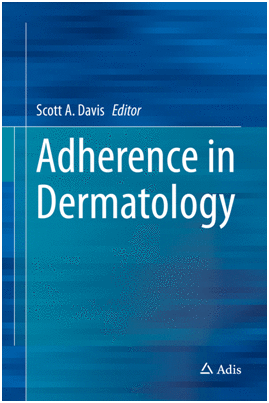
An essential, comprehensive, and practical guide to understanding, measuring, and modifying patients’ adherence behavior to optimize treatment outcomes, this book covers all major aspects of adherence in dermatology. The first section describes current knowledge on the magnitude and impact of nonadherence; the second outlines measuring adherence in the context of databases, trials and practice. The third section addresses adherence in key skin diseases and the fourth covers numerous strategies to improve adherence by mitigating specific patient barriers. All sections emphasize ways to optimize communication with patients: the foundation for producing successful health behavior change.
Low adherence helps explain why, despite effective treatments existing for all major dermatologic conditions, many patients still fail to improve. When clinicians endeavour to maximize adherence, with the aid of evidence-based strategies, these drugs will often realise their potential. This book devotes special attention to understanding why individuals may be nonadherent, so that each patient can receive a suitable treatment regimen, with a personalized plan of action.
This book is designed for clinicians at all levels, serving as both introductory training for medical students and residents, and an update on the field for experienced practitioners. Researchers and policymakers will also benefit from its coverage of research methods and the impact of nonadherence in specific diseases. Adherence in Dermatology bridges the gap between outcomes researchers and clinicians by explaining the latest findings in plain language, with examples from everyday dermatologic practice.
Features
• Acts as a practical guide to adherence measurement and improvement strategies, allowing clinicians to maximize the effectiveness of common treatments and elicit the best possible treatment outcomes
• Contains chapters devoted to adherence in specific important dermatologic disorders, enabling targeted methods to maximize adherence for each specific skin disease and regimen
• Provides training valuable to practicing physicians, residents and medical students, enabling all clinicians to implement the most up-to-date, evidence-based best practices related to adherence
• Addresses individually the specific reasons that patients may not adhere to their treatments, instructing readers how to overcome patients’ deficits in motivation, knowledge, behavioral skills, and memory
Author
Scott A. Davis is former Assistant Director of the Center for Dermatology Research at Wake Forest School of Medicine, and currently a PhD Candidate and Royster Fellow at the University of North Carolina Eshelman School of Pharmacy.
His research interest is primarily in developing effective interventions to improve patients’ adherence to treatments for chronic disease, using principles from behavioral economics.
He has published 85 papers and completed 2 books. He serves on the Editorial Boards of theAmerican Journal of Clinical Dermatology, Journal of Dermatology and Clinical Research, andDermatology & Therapy. He has also been awarded first prize in the Poster Walk at the 2011 meeting of ESPACOMP in Utrecht, Netherlands.
 -5%
-5%
 -5%
-5%
 -5%
-5%
 -5%
-5%
 -5%
-5%
 -5%
-5%
 -5%
-5%
 -5%
-5%
 -5%
-5%
 -5%
-5%