Descuento:
-5%Antes:
Despues:
120,04 €1 Introduction to Forensic Genetics 1
2 DNA:An Overview 7
3 DNA 27
4 Introduction to Forensic DNA Profiling – The Electropherogram (epg) 35
5 Biological Stains 49
6 Sources of DNA 57
7 Identification and Individualization 67
8 Transfer 71
9 Laboratory Accreditation 77
10 Validation 83
11 Extraction 95
12 Quantitation 103
13 Polymerase Chain Reaction (PCR) 111
14 Interpretation of Mixtures; Graphical 115
15 DNA Mixture Interpretation 129
16 Degraded Samples 137
17 Ceiling Principle: DNA 143
18 Y-Chromosome Short Tandem Repeats 145
19 Expert Systems in DNA Interpretation 151
20 Paternity Testing 159
21 Observer Effects 167
22 Databases 171
23 Missing Persons and Paternity: DNA 179
24 Familial Searching 189
25 Single Nucleotide Polymorphism 199
26 Mini-STRs 217
27 Phenotype 223
28 Mitochondrial DNA: Profiling 239
29 Geographical Identification by Viral Genotyping 245
30 Microbial Forensics 253
31 Wildlife Crime 265
32 DNA Databases – The Significance of Unique Hits and the Database Controversy 271
33 DNA Databases and Evidentiary Issues 279
34 Communicating Probabilistic Forensic Evidence in Court 289
35 Report Writing for Courts 301
36 Discovery of Expert Findings 307
37 Ethical Rules of Expert Behavior 315
38 Verbal Scales: A Legal Perspective 321
39 Direct Examination of Experts 327
40 Cross-Examination of Experts 331
41 DNA in the UK Courts 335
42 Legal Issues with Forensic DNA in the USA 347
43 Controversies in DNA 361
44 Future Technologies and Challenges 373
Index 385
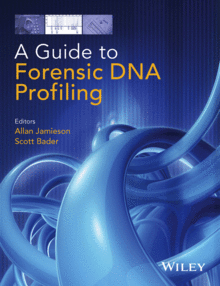
The increasingly arcane world of DNA profiling demands that those needing to understand at least some of it must find a source of reliable and understandable information. Combining material from the successful Wiley Encyclopedia of Forensic Science with newly commissioned and updated material, the Editors have used their own extensive experience in criminal casework across the world to compile an informative guide that will provide knowledge and thought-provoking articles of interest to anyone involved or interested in the use of DNA in the forensic context.
Following extensive introductory chapters covering forensic DNA profiling and forensic genetics, this comprehensive volume presents a substantial breadth of material covering:
• Fundamental material – including sources of DNA, validation, and accreditation
• Analysis and interpretation – including, extraction, quantification, amplification and interpretation of electropherograms (epgs)
• Evaluation – including mixtures, low template, and transfer
• Applications – databases, paternity and kinship, mitochondrial-DNA, wildlife DNA, single-nucleotide polymorphism, phenotyping and familial searching
• Court - report writing, discovery, cross examination, and current controversies
With contributions from leading experts across the whole gamut of forensic science, this volume is intended to be authoritative but not authoritarian, informative but comprehensible, and comprehensive but concise. It will prove to be a valuable addition, and useful resource, for scientists, lawyers, teachers, criminologists, and judges.
 -5%
-5%
 -5%
-5%
 -5%
-5%
 -5%
-5%
 -5%
-5%
 -5%
-5%
 -5%
-5%
 -5%
-5%
 -5%
-5%
 -5%
-5%